
THANK YOU ALL
A passion is something for which you have boundless enthusiasm. Do you know what your passions are?
People who love what they do, know their passions and do not turn into someone else when they go to work. They have integrity, and a strong sense of what their talents are. They build their careers on a foundation of self-knowledge and are devoted to developing their strengths.
People tend to spend too much energy on overcoming a weakness, instead of focusing on natural abilities and preferences. This wasted effort often comes from conditioning in schools and certain corporate settings. It is often unproductive to depend on an institution or employer for career development. Their motivations are not simply to help you in finding your true calling and may even run counter to your best interests. For example, an employer may want to keep you at your assigned tasks that you do well, even if you are ready to move on or up and learn something new.
Passions are preferences that inspire you in life and at work. For our purpose and discussion, there are four types of passions or work strengths:
All four aspects are vital in creating dream work that will balance interest, enjoyment, and challenge. To create a more authentic life you must first know and develop your passions. For many people, this is easier said than done. Many have forgotten what their passions are. Some have outgrown old passions and need to find new ones and others know what they are passionate about but instead of incorporating these things into their life and work, are disconnected from them and do not see a way back. Sometimes an unexpected event forces you to reevaluate what direction you want to take in your career.
Let today be a time of reflection and readjustment around your own talents and growth. Spend the day thinking about your passion in life.
Find your passion now.
Adapted from Laurel Donnellan (brightlivelihoods)
A few things to think about:
• Many of us have hobbies, knowledge, and experiences that can be turned into something useful in the marketplace. Give this some comprehensive thought. You probably have talents that could be further developed to create a career.
• Be proactive. Don’t be passive or fearful. Just taking the next step can get you to better and even great places. Start today.
• Be objective and strive to be your own counselor. Listen to others, but know the final decision is yours and hold yourself responsible. That in itself is empowering.
• If you haven’t given history enough attention, start doing so today. Realize you are in a pivotal time in history, and see it as a challenge as well as an opportunity.
• Each of us has a different route to our destiny and challenges are part of that path.
• Keep your self-image strong and intact by defining yourself in the best way possible—every day, no matter what the circumstances might be.
• Know from the inside out that you have the power to succeed and you will. That’s taking control. Your creative capital might be waiting to be discovered.
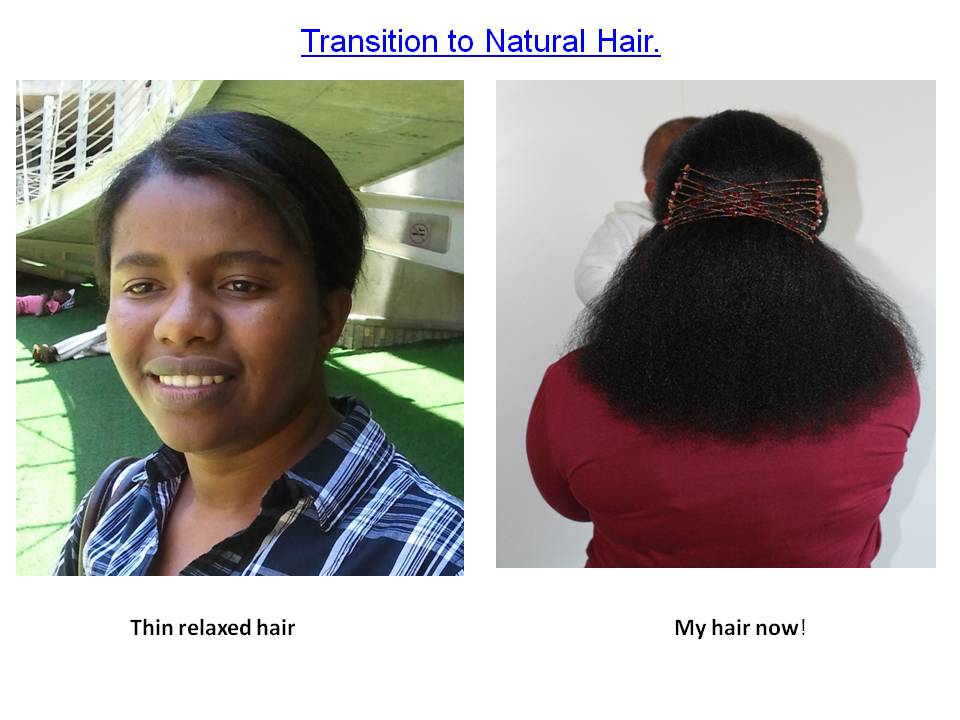
How to Transition to Natural Hair.
So you have decided to wear your hair in its natural state and rid yourself of the relaxers, perms and texturizers but you do not know where to start from and not sure of what you are up against? Transitioning is an option and below are a few tips to get you started.
1.Prepare your mind. I will not lie to you. Transitioning to natural hair is quite a challenge and your mind will have to get on board in order for you to make it. There will be so many people who will discourage you on your decision and you will fight many mind battles. Knowing why you are going natural in the first place and the challenges you may face along the way will help your mind not to go in panic mode when bad hair days come.
2.Deep condition at least once a week and co-wash your hair instead of shampooing it. Use a sulphate free shampoo if you can afford one otherwise use your regular shampoo sparingly. Deep conditioning will reduce breakage and will also keep both textures moist, soft and more manageable.
3.Keep your hair well moisturised at all times by spritzing it with water then sealing it with an oil of your choice every day, even twice a day if you feel your hair is very dry. A good moisturiser you can buy from any shop that sells hair products may help. Unfortunately you will have to try different products sometimes before you find one that agrees with your particular hair.
4.Oil treatments and protein treatments will help you get stronger hair that will not break easily. Do them regularly. Once or twice a month, alternating them helps.
5.Scab hair which tends to be dry may show up first and you might think that is your hair texture. This is only a result of scalp damage because chemicals. Keep deep conditioning and moisturising to realise your true texture which will come with time and may take longer for others.
6.Low manipulation styles should be your go-to styles while transitioning. The point where your relaxed hair joins the natural new growth is the weakest and too much manipulation will result in breakage at this point. Avoid excessive combing and brushing of your hair and tight hairstyles. Try Bantu knot-outs, twist-outs or braid outs. You can also roller set, flexi rod set or straw set your hair or tie it in a loose bun. Whatever you do, keep your hands out of your hair as much as possible.
7.Protective styling is also a way of getting some rest from having to deal with two different textures. Wear a sew-in weave or a wig to hide your hair for a while and to protect it from the harsh weather elements. You can braid or twist your hair with extensions to give your hair some volume because it tends to be very thin at the ends especially from month six into your transition. Twists on my hair without extensions used to look so sickly and unsightly when I was transitioning. With them on my hair, I would usually wear a hat to work or a scarf if I am around the house. Wearing hair extensions helped me not to obsess on my hair that seemed not to grow at all during my first year.
8.Avoid heat at all costs. Flat ironing your new growth to match your relaxed straight hair will do more harm than good. The heat will dry your hair even more and may result in more breakage.
9.Have patience. Transitioning is only a phase. It will soon pass and soon you will be able to wear your hair in its happy healthy kinky state. My transition was two years. It was not easy but it was all worth it. There are times when I thought, why the hack but I am glad I soldiered on.
Indeed it is a journey and all I wish is for you to take a step at a time and make it. Please don’t you ever look back and give up. Only look back to remind yourself why you made that decision to grow natural hair in the first place. When you are feeling ugly, look again in the mirror and just go, “wow, I’m beautiful.” All the best. Be blessed.
by RUTH MAFUPA
Do you find time to get inspiration? And do you know how to become inspired? Some of us depend on other people to inspire us, and at other times we need to find inspiration for ourselves. I wonder what you do to find inspiration? I want to share what works for me:
Finding my inspirational space is becoming more important to me as writing is getting more and more important in my life. But having inspirational space is not only for writing; it is for finding ideas, cleaning your thoughts and opening your mind. I use this time to reflect as well to balance my ideas to work in real life. But when inspiration is running on empty what do I do?
Some dreams are small, some are life changing, do dare to follow some of your dreams. And one of my best tips for inspiration is to share your knowledge. Teaching other people what I already know is one of my best inspirational sources as it gives great meaning and purpose to my life.
By Gina Abudi, on December 5th, 2012
John, the CEO of a sales organization, sent an email to Tim, an employee several levels below, to complement him on his performance in a recent meeting. Tim did not respond to the email.
About a week later, he was in John’s office applying for an open position that would have been a promotion into a management role, when John asked him whether he had received the email. Yes, Tim said, he had. Why, John asked, hadn’t he responded? Tim said he didn’t see the need.
But Tim was wrong. John’s email deserved, at the very least, a “thank you.”
Tim didn’t get the promotion. Was he passed over solely because he didn’t thank John for the positive feedback? No. But was Tim’s lack of response one piece of the Tim puzzle that convinced John he should choose a better candidate? Undoubtedly.
Before you accuse John of being trivial or over-sensitive, before you condemn his poor hiring judgment, consider what saying “thank you” represents.
On a basic level, it communicates that you received the email. While there’s a lot of advice that discourages writing “thank you” emails because they contribute to email overload, I disagree. I answer every real email I receive because I want to avoid the recipient’s “Did Peter get my email and what’s he thinking?” angst. It takes three seconds to respond “thanks” and it completes the transaction initiated by the sender.
But an email that contains emotional content — like a compliment — deserves something longer: a real, thought-out “thank you” as opposed to a simple I-received-your-email “thank you.” When you offer a real thought-out “thank you” to someone, you’re acknowledging her effort, appreciating her thoughtfulness, recognizing her intent, and offering feedback on the impact of her actions.
Still, it’s more than that. Those things are rational, but saying “thank you” is mostly an emotional act. It connects one person to another. Saying “thank you” doesn’t just acknowledge someone’s effort, thoughtfulness, intent, or action. It acknowledges the person himself.
Acknowledging other people is a critical responsibility — perhaps the critical responsibility — of a great manager, especially in sales. Actually great manager is too high a bar. I might say it’s the critical skill of a good manager but even that’s understating it.
Acknowledging each other is our basic responsibility as human beings living in community with other human beings.
Go ahead and argue: We’re all too busy at work and in life to spend time exchanging pleasantries. If John needs so much stroking, he can’t possibly be a good CEO. He’s out of touch with the digital age where no answers are the accepted norm. If Tim is doing his work well, that’s all that matters. People are paid to do their jobs and they don’t need to be thanked. Saying “thank you” to your CEO for a nice email is nothing more than brown-nosing.
I would disagree with all those arguments. It doesn’t take long to say “thank you,” but it does take caring. John is an excellent CEO, with a staff, board, and shareholders who love him and for whom he delivers a high growth rate and excellent results. Not answering someone’s communication — text or email or phone call — is not an accepted norm, it represents a fundamental breakdown in communication about which I often hear people complain. Tim might be good at certain aspects of his job but he’s not “doing his work well,” if he’s not acknowledging the people around him. And, finally, saying “thank you” isn’t brown-nosing, it’s nice.
This all becomes more obvious if you take away the digital element. How would you feel if you complimented someone in person and he just walked away from you without saying anything? Weird, right?
Saying “thank you” — sincerely and with heart — feels good. Not just to the person receiving it, but also to the person offering it. And that’s part of work too. It’s hard to remember, as we process our hundredth email, that behind each message is a person..
Tim made a mistake by not appreciating John’s effort or acknowledging his sentiment. I don’t want to make that same mistake.
Peter Bregman (HBR Blogger)
More often than not, Christian businessmen or professionals seem to operate in two separate worlds; a deeply personal, private, spiritual world and a very public, demanding, competitive business world. For most part, these two worlds clash in their values, beliefs, and principles, and Christian are caught in the middle. This dilemma commonly presents itself as an internal struggle between right and wrong.
If you trust in God’s principles, you must have the courage to live by them. Biblical principles and bottom-line success are not opposites. Yes, Christians can do what’s right and be successful. Yes, they can be both ethical and profitable. And yes, they can honor God, serve others, and fulfill their professional obligations.
God did not call Christians to be victims of circumstances. God calls Christians to grow closer to Him by courageously working through their dilemmas. He wants Christian to prosper, to be valuable leaders, and to serve as models to help others.
When Christians integrate Gods principles with their unique talents, skills, and character, they create powerful partnership for being successful in the world without becoming of the world.
God’s wisdom, their spiritual core, is the source of strength, purpose, and direction. God’s wisdom, their spiritual core also serves as a balance to their skills and abilities. The Christian character is the aggregate sum of who they are as they courageously follow through and do what’s right over time. Their overall productivity is the legacy they leave behind.
Like diamonds, godly leaders should brilliantly reflect God’s nature in all circumstances and shine brightly in the toughest times.
Oh, what a night! It was all stacked against the Blues but they forged a memorable victory.
Chelsea did the impossible: they pulled off something new under the sun, something never seen before, a rearguard action of heroic dimensions.
Stuff purism; this was one of the great nights, simply because it was about more than just beauty and technique. It was about bravery, determination, a refusal to bow, a triumph of sheer will. It was Chelsea’s destiny to leave Catalonia defeated, as most teams do. They changed the narrative; they made this happen, somehow.
Think of the concentration, think of the resolve. It was at the lowest point, two goals and a man down. Then consider that, from there, Chelsea drew the game 2-2.
Sometimes there come some games along that are impervious to common sense. This is one of them.
Why did Chelsea qualify to reach the finals in Munich? Because they really, really wanted to. This is a testament to an outstanding group with determination to succeed.
We can all learn from Chelsea. When they were 2 goals down, they never complained, nor felt sorry for them selves nor accepted their situation as being the weaker team playing against the best team in the world. They looked forward to the challenge of making things right-jumping over the hurdle of Barcelona and being at Munich for the finals. This they achieved through bravely, determination and a refusal to bow – a triumph of sheer will
Teams can attain phenomenal success in business or achieve great things if they can choose to view setbacks as ‘body blows’ and not as ‘knocked outs’ or view it is as stepping stones.
Champions are born and champions are made. One definition of a champion is someone who shows marked superiority. Another definition is someone who is a winner of first prize or first place in competition. We’ve all seen Olympic champions on television. What comes to mind when I see their amazing ability is the amount of training they have endured, the sacrifices they’ve made, and the courage they’ve had to have to get where they are. Those are some of the attributes of a champion.
Champions also want to achieve something special. Ordinary wouldn’t be enough for someone who has the mindset of a champion. Champions think big. Champions work in a big-time way. Champions are focused. Champions are disciplined. Come to think of it, champions think like champions. A champion is someone who gets up when he can’t. Let’s hope that applies to you.
You can learn a lot from watching the experts, whether you’re interested in sports, the arts, or whatever. One thing they all have in common is the same mindset: They want to win; they want to be the best. Not the runner-up, but the best. That’s a very important thing to consider. I’ve seen very talented people fail because deep down I think they were afraid of winning. Winning comes with a responsibility. Champions rise to that responsibility. Search yourself carefully to make sure you’re ready and capable. If you’re not, do something about it. It’s an important element of success. We win in our daily lives by being careful with every day, by having a champion’s view of each moment.
Why set your goals too low? Did you ever hear a child saying they want to be nothing when they grow up? They are full of dreams and plans, and rarely are they mediocre aspirations. They want to be presidents, doctors, astronauts, scientists, and so on. They’re on the right track and have the right mindset. That’s the first step—and a daily responsibility for a champion.
Champions go the extra mile. We all know when we’ve done just enough and when we’ve really exerted ourselves. Make an effort to exert yourself—every day. Don’t fail because you never allowed yourself to get started! Don’t avoid success because you think the responsibility might be too much—just focus and get going! You’d be surprised at what intelligent effort can produce. The sun’s rays do not burn until brought to a focus.
Pay attention to these things and you will be on your way to thinking like a champion—and becoming one.


 Attaconsult.com